The Real Problem Isn't Your Process—It's Your Platform
Across the industry, the same issues show up again and again:
- Communication breakdowns
- Lack of financial visibility
- Manual, time-consuming processes
- Frustrated residents and burned-out teams
These aren't random problems—they're symptoms of outdated systems. HOA leaders consistently cite inefficient communication, lack of transparency, and manual workflows as core operational challenges. And when your software can't keep up, everything else starts to slip.
Sign 1: Your Team Is Stuck Doing Manual Work
Spreadsheets, email chains, and workarounds are the daily norm
If your daily operations still rely on spreadsheets, email chains, and workarounds, your system isn't supporting you—it's slowing you down. Outdated tools often force teams into manual processes and disconnected workflows, which reduce efficiency and increase the risk of errors (Vinteum).
Even worse? These inefficiencies compound over time:
- Tasks take longer
- Mistakes increase
- Productivity drops
Key insight: This isn't a people problem. It's a systems problem. The right platform automates repetitive tasks so your team can focus on what actually matters.
Sign 2: Communication Feels Disorganized (and Residents Feel It)
Paper notices, email blasts, and word-of-mouth aren't cutting it
Communication is the backbone of any HOA—and one of its biggest failure points. Many communities still rely on paper notices, email blasts, and word-of-mouth updates. The result? Confusion, frustration, and conflict.
Research shows that poor communication leads to resident dissatisfaction, misunderstandings, and increased violations simply because people aren't informed. And when communication breaks down, something bigger happens: trust erodes.
Residents begin to feel ignored. Boards appear unresponsive. Small issues escalate into bigger ones.
Sign 3: You Don't Have Clear, Real-Time Visibility
Basic questions take too long to answer
How long does it take you to answer basic questions about your HOA? Financial standing, delinquencies, open violations, project status—if the answer is "too long," your system is costing you more than time.
Many HOA boards struggle with delayed or incomplete reporting, limited financial visibility, and slow access to critical data. That creates a dangerous ripple effect:
- Slower decision-making
- Increased financial risk
- Lack of confidence from residents and board members
You can't lead what you can't see. Real-time dashboards aren't a luxury—they're table stakes for modern HOA management.
Sign 4: Growth Creates Friction Instead of Progress
Adding communities or scaling operations exposes every weakness
Adding new communities or scaling operations should feel like growth—not pain. But with the wrong software, growth exposes every weakness:
- Systems don't integrate
- Workflows break
- Costs increase
Choosing the wrong HOA platform can stall growth, reduce ROI, and even lead to costly re-implementation within a few years. That's not just inefficient—it's expensive.
Sign 5: Your Team Avoids Using the System
The clearest signal—and the one most teams ignore
If your team avoids logging in, complains about usability, or creates side systems to get work done, your software has already failed. Poor usability leads to low adoption, lost productivity, and wasted investment in tools that no one actually uses.
And when adoption drops, something dangerous happens:
- Shadow systems take over
- Data becomes inconsistent
- Accountability disappears
Warning sign: If your team has built workarounds around your software, the software has already lost. Adoption is the ultimate measure of a platform's success.
What This Is Really Costing You
These issues don't exist in isolation—they stack. Outdated HOA systems contribute to:
- Burnout from manual workload and inefficiency
- Resident frustration driven by poor communication
- Lack of transparency and trust across the community
Over time, this leads to a bigger problem: your HOA becomes reactive instead of proactive. And once you're in that cycle, it's hard to break out.
Manual vs. Modern: The Real Difference
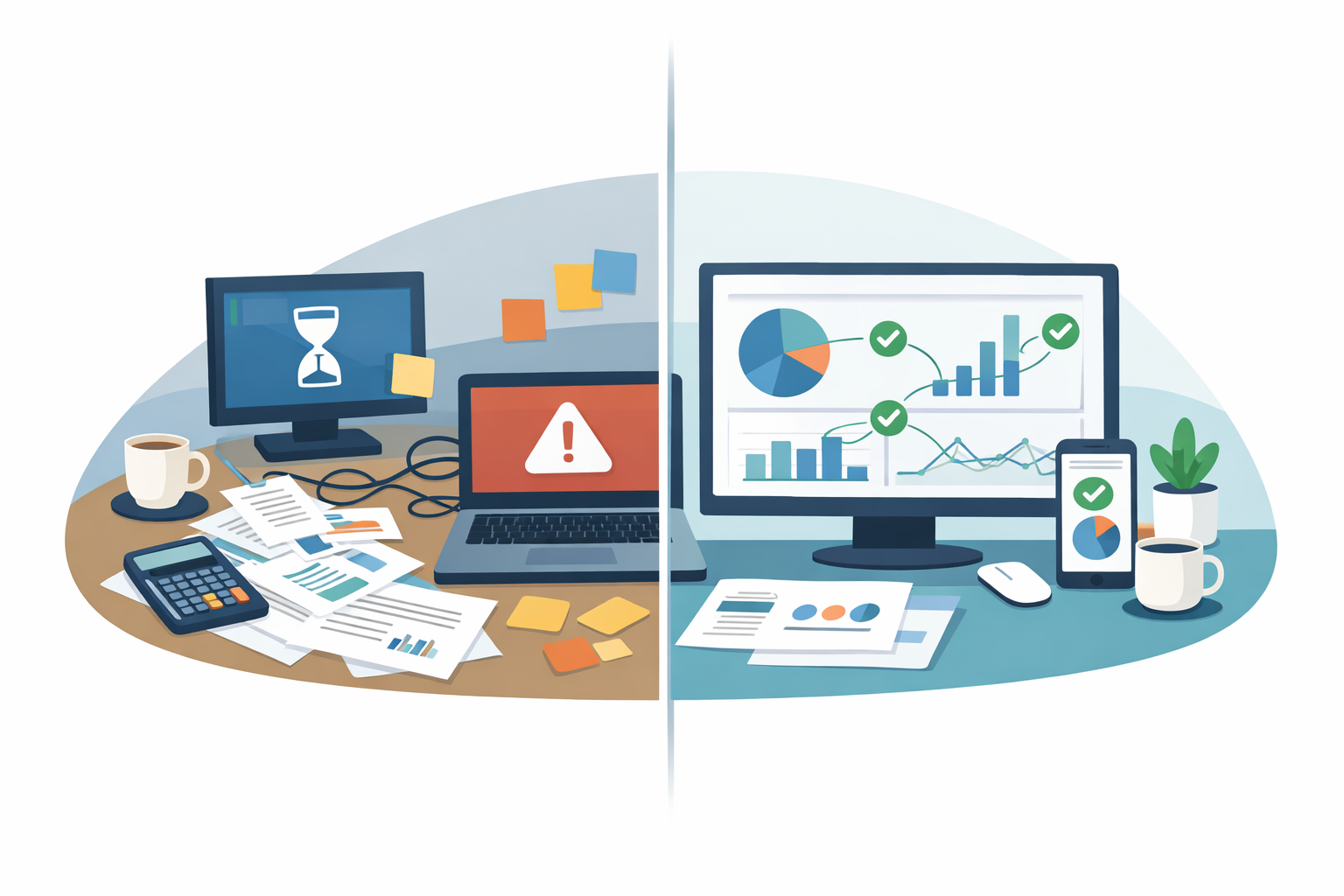
Outdated platforms are reactive, inconsistent, and labor-intensive. Modern HOA platforms are proactive, predictable, and scalable. One depends on people remembering. The other guarantees it gets done.
Modern HOA platforms aren't just incremental upgrades—they fundamentally change how communities operate. Instead of patching together tools, they unify communication, operations, financials, and reporting into one system designed for how HOAs actually function.
There's a Better Way to Run an HOA
Modern HOA platforms aren't just incremental upgrades—they fundamentally change how communities operate. Instead of patching together tools, they unify everything—communication, operations, financials, and reporting—into one system designed for how HOAs actually function and helps you control the flux.
Meet HOAFlux
Built for control in a constantly changing environment. HOAFlux replaces outdated systems with a platform that brings clarity, automation, and visibility to every part of your operation:
- Automated workflows that eliminate repetitive admin work
- Centralized communication that keeps everyone aligned
- Real-time dashboards for instant decision-making
- Scalable infrastructure that grows with your portfolio
- Intuitive design your team will actually use
Stop Managing Around Broken Software
You don't need more tools. You need the right system. Because when your platform works, your entire HOA works better.
See HOAFlux in Action