
Architectural review is one of the most important responsibilities an HOA board undertakes—and one of the most difficult to manage efficiently.
Every exterior modification, from paint colors and fences to solar panels and major renovations, must be reviewed, documented, and approved in accordance with the association's governing documents. Done well, the ARC process protects property values, preserves community standards, and reduces disputes. Done poorly, it creates delays, inconsistency, homeowner frustration, and compliance risk.
The challenge is that many associations are still managing architectural reviews with paper forms, spreadsheets, and endless email chains. As request volume increases, these manual processes become harder to track, harder to enforce, and harder to scale.
Every ARC request introduces risk. Miss a deadline, lose documentation, approve similar projects inconsistently, or fail to communicate clearly with homeowners, and a simple improvement request can quickly become a board headache. Most ARC challenges aren't caused by the rules themselves—they're caused by the process used to manage them.
That's why more communities are turning to ARC review automation.
By digitizing the entire review process—from submission and routing to approval and recordkeeping—automation helps boards improve compliance, accelerate decisions, reduce administrative burden, and create a better homeowner experience.
In this guide, we'll explore how ARC review automation works, the benefits it delivers, and how modern HOA boards are using technology to streamline architectural reviews while maintaining complete control over the decision-making process.
Why Traditional ARC Processes Break Down
The ARC process rarely fails because of the committee.
It fails because of the workflow.
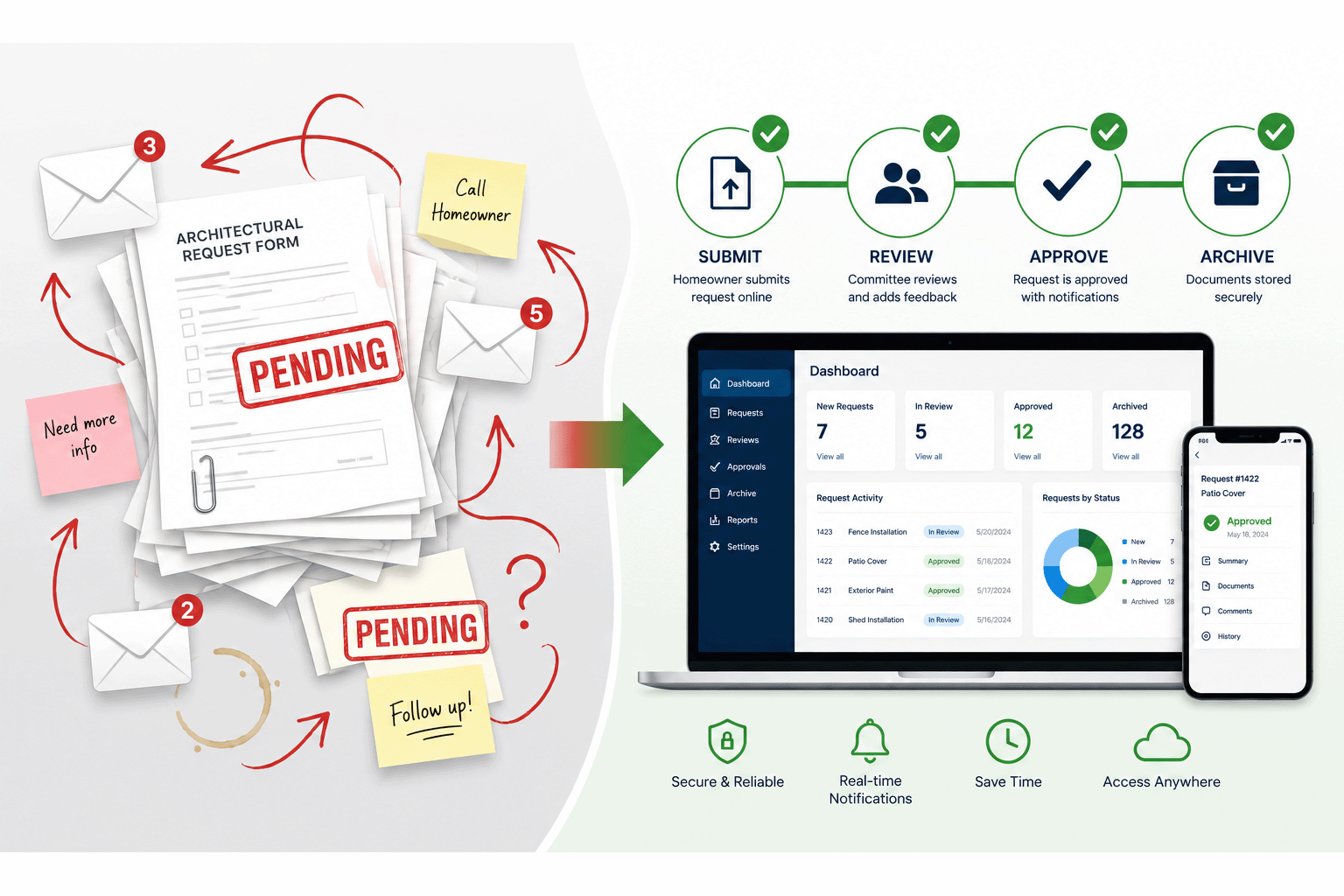
In many communities, architectural requests still move through a patchwork of paper forms, email chains, spreadsheets, shared drives, and manual follow-ups. What starts as a simple homeowner request quickly becomes an administrative burden.
A typical process often looks like this:
- Homeowner submits a paper form or email
- Supporting documents arrive separately
- Committee members review requests independently
- Questions are exchanged through multiple email threads
- Status updates require manual follow-up
- Decisions are recorded in spreadsheets or meeting notes
- Documentation is stored in multiple locations
Even well-run communities eventually hit a ceiling with this approach.
As requests increase, manual processes become slower, less transparent, and harder to manage consistently.
Why Manual ARC Reviews Create Risk
Most ARC processes don't fail overnight.
They slowly become harder to manage as communities grow and expectations increase.
Delayed Decisions
Applications sit waiting for committee members to locate documents, review materials, or respond to emails.
Inconsistent Enforcement
Without easy access to historical approvals, boards may unknowingly approve one project while denying a nearly identical request later.
Homeowner Frustration
The most common complaint isn't denial—it's uncertainty. Homeowners want visibility into where their request stands and what happens next.
Documentation Gaps
When records are spread across inboxes and file folders, boards can struggle to defend decisions if questions or disputes arise later.
Board Burnout
Volunteer board members often spend more time tracking requests and paperwork than reviewing the actual merits of a project.
5 Signs You've Outgrown Your ARC Process
If any of these sound familiar, the issue probably isn't your ARC committee—it's your workflow.
- Homeowners regularly email or call asking for status updates.
- Applications arrive through multiple channels and formats.
- Committee members struggle to find previous approvals.
- Decisions are tracked in spreadsheets, email folders, or meeting minutes.
- Reviews frequently take longer than expected because documents are missing or communication gets delayed.
These are signs that your process is creating unnecessary work, risk, and frustration for everyone involved.
What ARC Review Automation Actually Does
ARC automation doesn't replace the board.
It replaces the chaos.
The board retains complete authority over every decision. Automation simply ensures requests move through a consistent, transparent, and documented process every time.
A homeowner submits a request once through a platform like HOAFlux.
From there, the system handles the administrative work:
- Routing requests to the appropriate reviewers
- Organizing all supporting documents
- Tracking comments and decisions
- Sending status updates automatically
- Maintaining a complete compliance record
The result is a process that's easier for homeowners, committee members, managers, and boards alike.
The Modern ARC Workflow
Digital Submission
Modern ARC platforms like HOAFlux allow homeowners to submit requests through structured online forms that require the appropriate documents, photos, plans, and project details upfront. No incomplete forms. No missing attachments. No guessing.
Automatic Routing
Requests are automatically assigned to the appropriate reviewers based on your community's workflow. No forwarding emails. No chasing approvals.
Centralized Review
Committee members review requests from a shared workspace where comments, documents, revisions, and recommendations stay attached to the application. Everyone works from the same information.
Clear Decision Management
Approvals, denials, and revision requests are documented with timestamps and supporting notes. Every decision has context.
Automated Homeowner Communication
Homeowners receive updates throughout the review process and can track the status of their request without contacting management or board members.
Permanent Documentation
Every submission, communication, attachment, and decision is stored in a centralized record that creates a complete audit trail.
How ARC Automation Improves Compliance
Architectural review isn't just about approvals.
It's about applying community standards consistently and fairly.
Automation helps boards strengthen compliance by ensuring:
- Every request follows the same workflow
- Every decision is documented
- Every action is time-stamped
- Every approval has supporting context
- Every historical record is easily accessible
Consistency is one of the strongest protections an HOA board can have.
What to Look for in ARC Review Software
Not all ARC platforms are created equal. When evaluating ARC review software, look for:
- Online Submission Forms: Reduce incomplete applications and eliminate paper forms.
- Automated Routing: Ensure requests reach the right reviewers automatically.
- Centralized Document Storage: Keep plans, photos, comments, and approvals attached to every request.
- Approval Tracking: Know exactly where every request stands.
- Homeowner Notifications: Reduce status inquiries and improve transparency.
- Audit Trails: Maintain a complete compliance history.
- Mobile Accessibility: Allow board members and committee reviewers to participate from anywhere.
- Reporting and Visibility: Track request volume, approval timelines, and community trends.
The Modern Solution
Most HOA boards aren't failing at ARC reviews—they're drowning in outdated processes.
Paper gets lost. Emails pile up. Reviews stall. Homeowners get frustrated. And boards end up spending more time tracking requests than actually making decisions.
That system doesn't scale anymore.
The communities handling this well have moved to automated ARC workflows that bring everything into one place—submission, review, decision, and documentation—fully transparent and always up to date.
HOAFlux replaces ARC bottlenecks with a streamlined digital workflow that keeps boards, committees, managers, and homeowners aligned from submission to approval.
No paper trails. No status-chasing. No missing documentation.
Just faster decisions, stronger compliance, and a better experience for everyone involved.
Control the ARC fluxery, start your free trial today.
Bring structure, speed, and transparency to your Architectural Review Committee requests.
Start Free Trial