New residents move in. Vendors change. Budgets evolve. Documents pile up. Board members rotate. Compliance requirements shift.
Now Florida has added another major responsibility to the list.
As of January 1, 2025, Florida homeowners associations with 100 or more parcels are required to post specified official records on a website or make them available through a downloadable mobile application under Florida Statute 720.303(4)(b).
If your board is still managing documents through email chains, shared drives, paper binders, or a patchwork of disconnected systems, the requirement is already in effect — and compliance means more than simply launching a website.
What Florida HOA Boards Need to Know
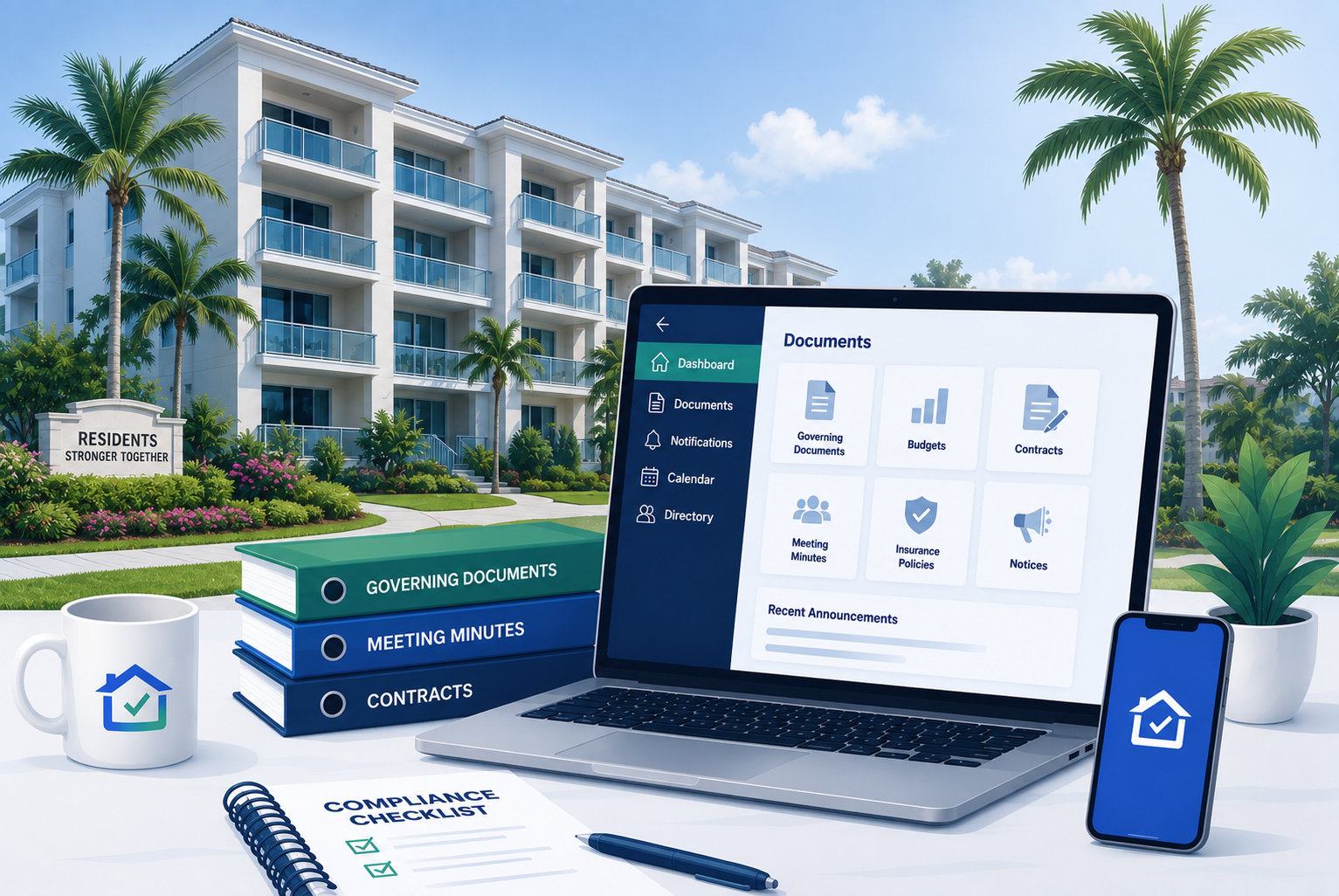
Under the updated Florida statute, qualifying associations must provide homeowners with access to key records through an official website or secure portal. Required documents may include:
- Governing documents
- Budgets
- Contracts
- Insurance policies
- Meeting notices, agendas, and required meeting materials
- Required notices
- Other official association records required by law
The platform must also provide secure access for homeowners while protecting sensitive information that should not be publicly available. Certain records may require redaction before publication.
For many boards, this represents a significant operational shift.
The question isn't simply: "Do we have a website?"
The real question is: "Can we consistently manage, organize, secure, update, and distribute association records in a way that satisfies Florida's requirements?"
Compliance Is About More Than a Website
A website is only the front door.
Behind it, your association needs a system capable of handling every layer of the requirement:
Document Management
Store governing documents, contracts, insurance records, meeting minutes, architectural requests, and board records in one secure location — accessible and up to date when residents or regulators come looking.
Resident Access
Provide homeowners with self-service access to important information without generating endless email requests. Residents expect on-demand access; the statute requires it.
Communication Management
Keep notices, announcements, and updates centralized and accessible. Required notices aren't just records — they're proof of proper governance when disputes arise.
Board Continuity
Ensure institutional knowledge doesn't disappear every time board members change. A compliant system keeps records intact across transitions — not locked in someone's personal inbox.
Security & Privacy
Protect sensitive information while maintaining transparency and compliance. Some records must be publicly accessible; others require redaction or restricted access. Your platform needs to handle both.
Why Many Boards Are Rethinking Legacy HOA Software
Now that the requirement is in effect, many associations are discovering that traditional HOA software platforms can be expensive, complicated, and overloaded with features they rarely use.
The reality is simple. Most boards want a solution that is:
- Easy to deploy
- Easy to learn
- Easy for residents to use
- Affordable for the community
- Built to support compliance without creating more work
That's where modern HOA technology is changing the conversation.
Platforms designed around simplicity — not feature bloat — let boards spend less time managing software and more time managing their community. When compliance is built into the workflow rather than bolted on as an afterthought, associations can meet statutory requirements without adding significant administrative overhead.
Control the Flux Before It Controls You
The Florida website requirements are ultimately about transparency, accessibility, and better community management.
Boards that haven't yet put a compliant system in place are already behind — and scrambling to organize years of records under pressure is far harder than building the right foundation from the start. Boards that act now can still streamline operations, improve homeowner communication, and get ahead of the next compliance obligation before it arrives.
Because compliance shouldn't feel like chaos.
And your HOA shouldn't have to manage it with spreadsheets, email chains, and crossed fingers.
The associations that navigate this successfully won't just be the ones that technically launch a website — they'll be the ones with the operational systems behind it to keep it current, secure, and useful.
Ready to See What's Possible?
HOAFlux was built specifically to help HOAs simplify operations, centralize records, improve communication, and give residents the self-service experience they expect — all without the cost and complexity of many traditional HOA platforms.